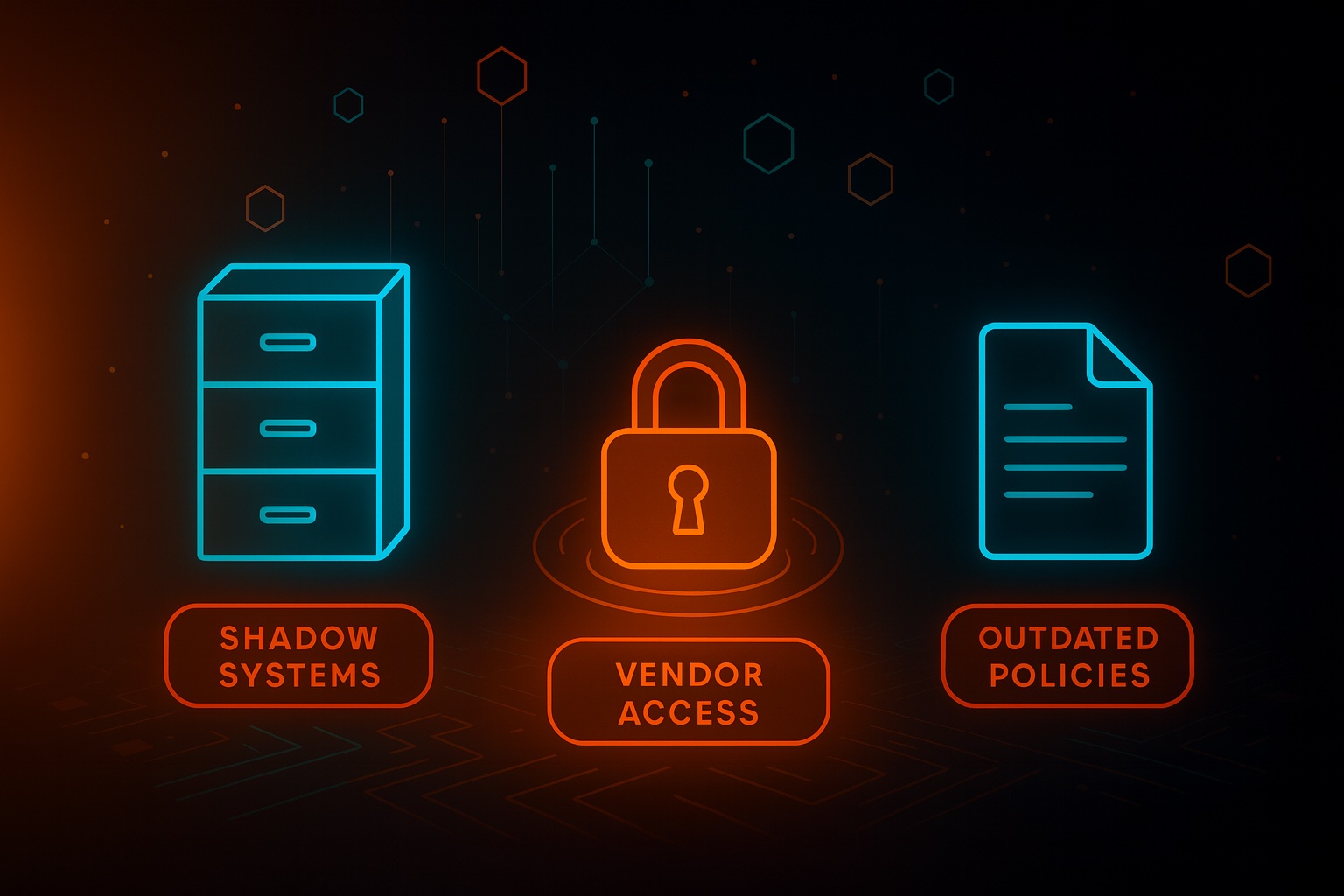
How Shadow Systems, Vendor Access, and Outdated Policies Are Undermining Your Compliance
“We thought it was just a reporting tool…”
That’s how it usually starts.
A dashboard spun up in Power BI. A “temporary” data extract pushed to a vendor portal. A no-code app built by a business unit that was never formally approved.
None of these tools look risky on the surface. But for banks navigating growing regulatory pressure, each one represents a governance blind spot—and regulators are no longer ignoring them.
Shadow Systems: How Regulated Data Slips Through the Cracks
Shadow IT has evolved far beyond spreadsheets or legacy SharePoint folders. Today’s version includes entire ecosystems of lightly monitored or informally adopted tools—cloud analytics platforms, business-managed integrations with systems like Salesforce or nCino, and operational reporting environments that live outside your enterprise data architecture.
Here’s how risk builds:
- A data export is shared to speed up underwriting.
- A marketing team connects a vendor to CRM data.
- A business user builds a dashboard in a sandbox that becomes operational over time.
Over weeks and months, these small moves accumulate—leaving critical data outside formal governance channels. No lineage. No lifecycle controls. No audit trail.
The problem isn’t intent. It’s drift. Systems that were meant to be “short term” become essential, without anyone updating policies, assigning ownership, or enforcing access restrictions.
For a deeper look at how different teams misinterpret governance responsibilities, see:
Data Governance vs. Data Security vs. Data Quality
Vendor Access: Why Contracts Don’t Equal Controls
Many financial institutions feel confident about vendor governance because “we have contracts.” But that confidence rarely holds up under scrutiny.
Examiners now routinely ask:
- Which specific datasets can this vendor access?
- How is that access granted, logged, and revoked?
- What breach protocols and retention standards are enforced—and can you prove it?
Even mature vendor management offices often stop short of the data layer. Contracts get signed, but no one checks whether data access aligns with policy. Worse, many banks discover during audit prep that vendors retain access years after a project has ended.
A modern vendor risk posture includes:
- Centralized visibility into what each vendor can access
- Documentation of onboarding and offboarding triggers
- Alignment between data classification and access level
- Regular access reviews tied to risk tiers
Learn why this is one of the top red flags for regulators:
Third-Party Risk in Banking: Why It’s a Regulatory Hotspot
Policy Decay: When Governance Exists on Paper Only
Having a policy isn’t the same as enforcing one.
Many banks still rely on governance documentation created before their current cloud stack, integrated platforms, or analytics environments were in place. That means:
- Data retention policies that don’t apply to SaaS tools
- Access policies that only cover on-prem environments
- Ownership models that reflect departments, not domains or systems
Even when policies do exist, regulators often flag vague language and outdated enforcement mechanisms. A key indicator: reliance on words like “should” or “may” without clear accountability or technical enforcement.
You can’t govern modern data with legacy paperwork. Policies must evolve to reflect current data behaviors, system interdependencies, and regulatory scrutiny.
Not sure how regulators expect policies to evolve as you grow?
Navigating Heightened Standards: What Growing Banks Need to Know
What Examiners Are Actually Asking Now
Regulators are no longer just scanning for documentation. They are probing for operational maturity. Common asks include:
- “Who owns this dataset, and how do they enforce retention?”
- “What happens when a vendor relationship ends?”
- “Show us a sample data lineage from core system to board report.”
- “When was this policy last reviewed, and by whom?”
- “What’s your deletion process for customer PII in SaaS Platform X?”
These questions are not hypothetical—and the ability to answer them with clarity, consistency, and evidence is what defines regulatory readiness today.
Five Moves to Regain Control
You don’t need to rebuild your entire governance program. But you do need to take action on the data and systems already slipping through the cracks.
Here’s where to start:
- Inventory systems and tools
Capture where regulated data lives—including user-led environments, vendor portals, and self-service platforms.
Quick win: Use automated metadata tools to scan for undocumented data assets. - Classify data based on sensitivity and use
Apply consistent classifications across platforms. Confidential. PII. Regulatory reporting. Internal use.
Quick win: Start with high-risk systems like customer data platforms and lending tools. - Define ownership
Assign and document accountable owners for each dataset, platform, or business domain.
Quick win: Use a RACI model to clarify decision-making vs. stewardship responsibilities. - Update and enforce key policies
Focus first on the policies that intersect with high-risk areas: access, retention, lifecycle, vendor governance.
Quick win: Launch a quarterly policy review cycle with IT, Risk, and Line of Business leaders. - Set lifecycle triggers
Define when data should be archived, reviewed, or deleted—and automate those triggers wherever possible.
Quick win: Start with inactive datasets and terminated vendor environments.
These are not theoretical recommendations. They reflect how modern governance actually scales—especially when examiners expect maturity even under the $50B threshold.
Final Thought: You Don’t Need to Fix Everything. Just Start Seeing It.
Most breakdowns in data governance aren’t caused by bad decisions. They’re caused by gaps—between policy and practice, between IT and business teams, between core systems and the growing constellation of platforms surrounding them.
The fastest way to reduce risk is not to centralize everything at once. It’s to get visibility into what you currently can’t trace, defend, or explain.
Because when regulators ask hard questions, “we thought it was just a reporting tool” is not a defense. It’s a warning sign.
Next Step: Know Where You Stand
Not sure how exposed you are? Start with our simple Readiness Scorecard or book a brief session with our data governance advisors.
We’ll help you spot blind spots before your auditors do, and prioritize next steps based on risk, not theory.