Can Our Data Be Trusted at Scale?
Governance and Data Integrity.
Data becomes strategic only when it is consistent, owned, and continuously monitored. Without shared definitions and embedded quality controls, confidence degrades. Stabilizing the foundation ensures that scale increases reliability rather than risk.
Define Ownership
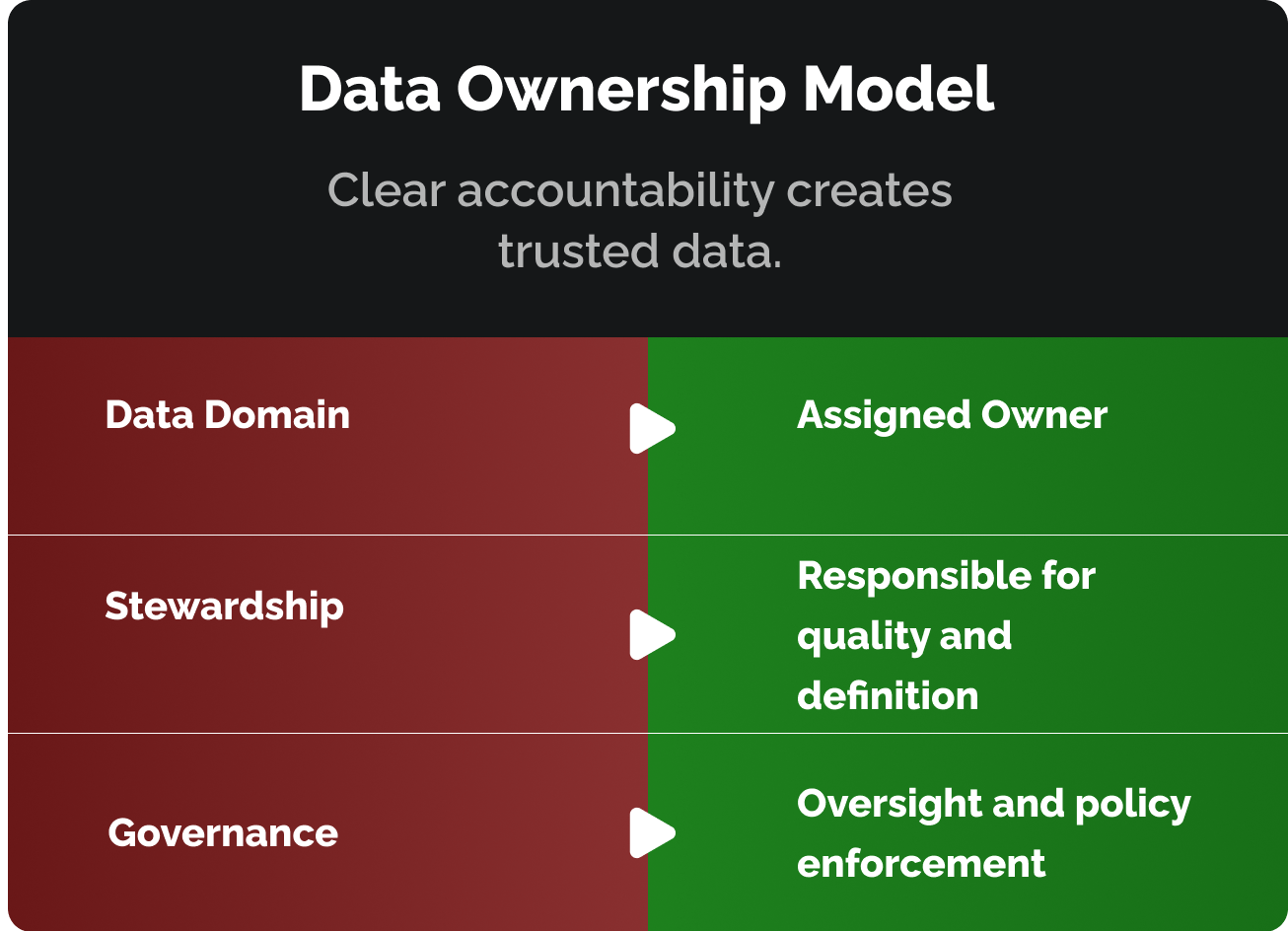
Data becomes unreliable the moment ownership becomes unclear. When no one is responsible for a dataset, definitions drift, quality degrades, and teams begin creating their own versions of the truth. A scalable data environment requires clearly defined ownership across domains.
Each critical dataset should have a designated owner responsible for its accuracy, accessibility, and lifecycle. Data stewards support this responsibility by managing definitions, monitoring quality, and ensuring proper use.
Ownership turns data from a shared liability into a managed asset. When accountability is explicit, issues are resolved faster and trust grows across the organization.
"Governance fails when accountability is implied instead of assigned."

Standardize Definitions
Organizations rarely struggle with a lack of data. They struggle with inconsistent meaning.
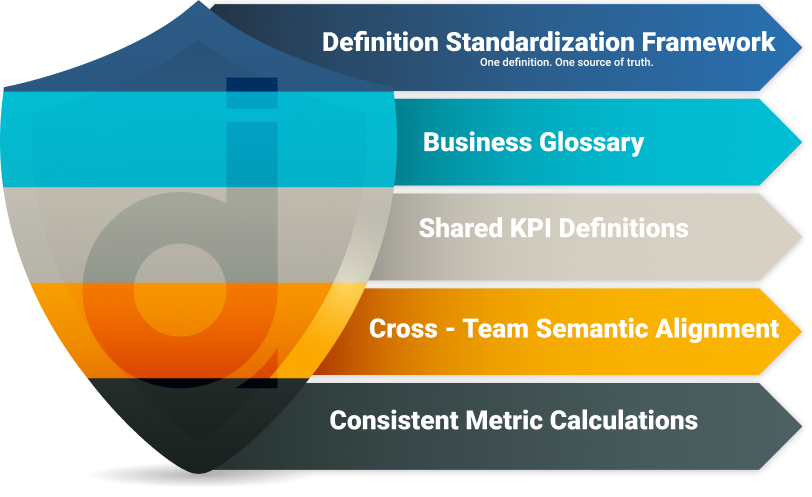
When revenue, customer, utilization, or risk are defined differently across teams, reporting becomes negotiation instead of insight. Analysts spend more time reconciling numbers than analyzing them.
Standardized definitions solve this problem at the root. A shared business glossary aligns terminology across systems and departments, ensuring that metrics are calculated the same way everywhere they appear.
When definitions are consistent, dashboards become trustworthy and decisions become faster.
"If every department defines metrics differently, your data platform becomes an argument instead of an asset."

Embed Data Quality Controls
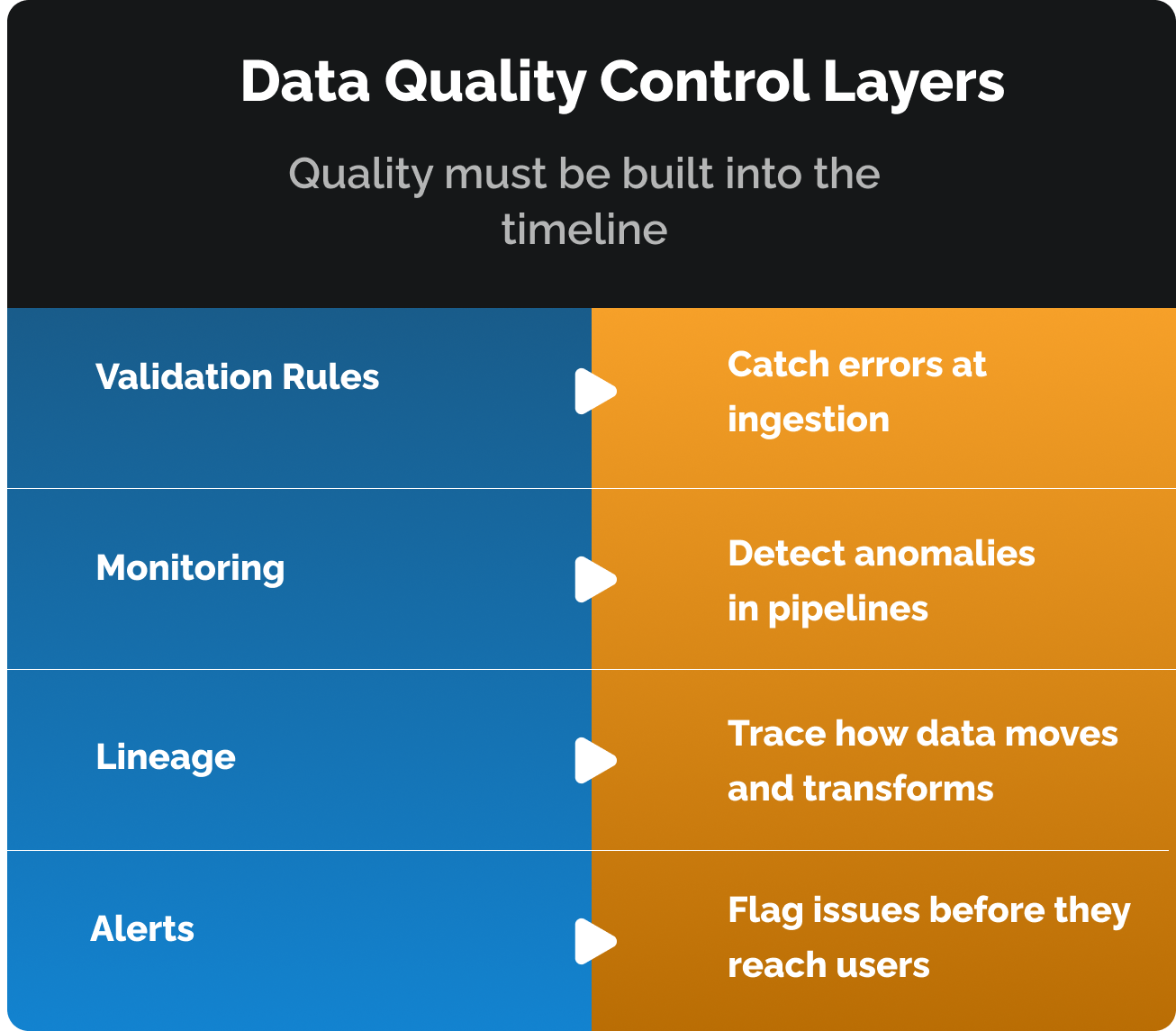
Trust cannot depend on manual validation. As data volume grows, quality must be engineered directly into the system.
Embedded data quality controls continuously validate inputs, monitor anomalies, and track lineage across the data lifecycle. These controls detect errors early and prevent unreliable information from spreading across reports, dashboards, and AI models.
Quality monitoring transforms governance from reactive cleanup to proactive protection. Instead of discovering problems after decisions are made, organizations detect and correct issues at the source.
"AI doesn’t fix bad data. It amplifies it. "

Establish Governance Discipline
Governance is often treated as documentation. In reality, it is an operational discipline.
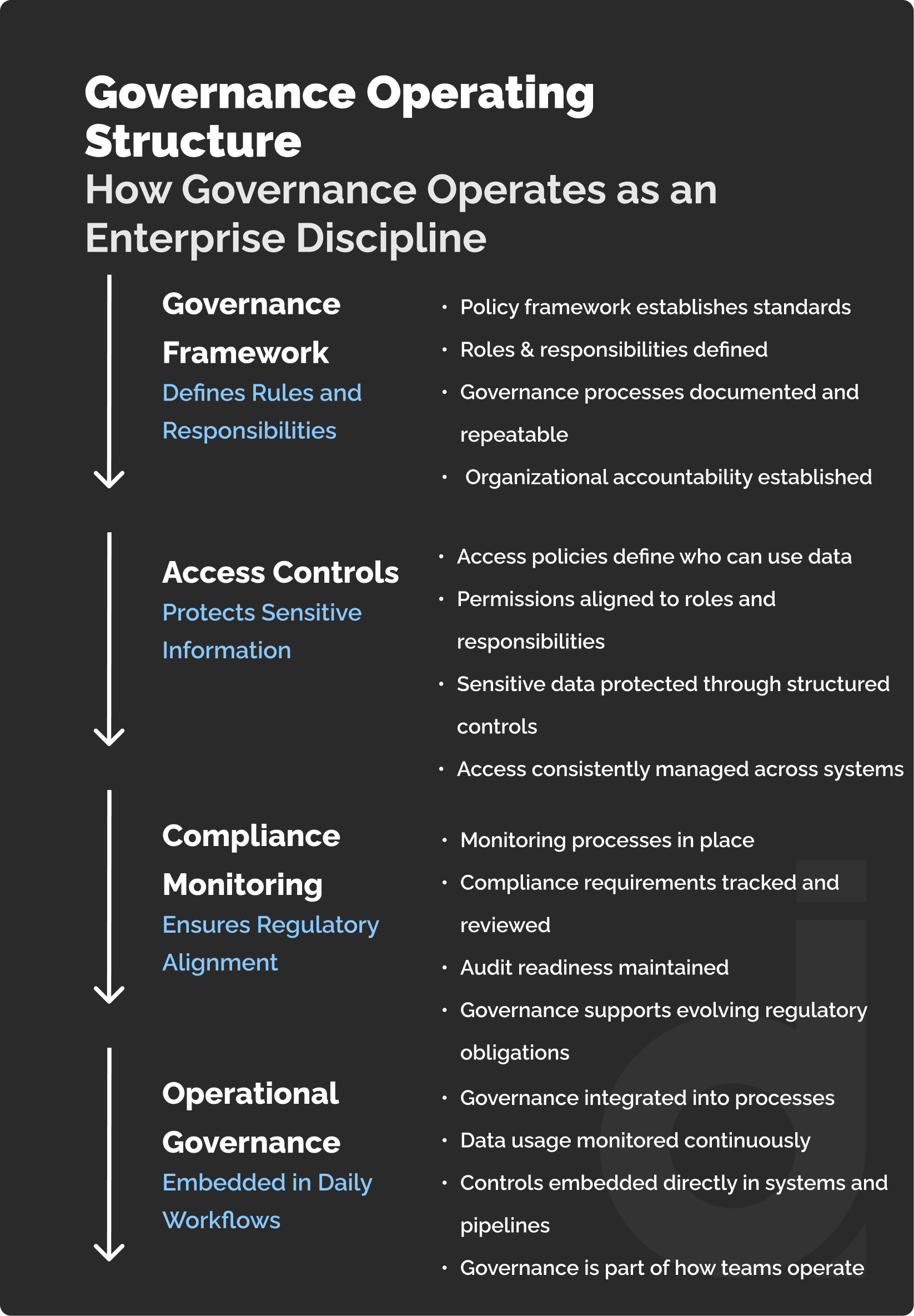
Effective governance defines how data is accessed, protected, and managed across the enterprise. Policies establish expectations, access controls protect sensitive information, and compliance structures ensure regulatory alignment.
But governance only works when it becomes part of daily operations. It must be embedded in architecture, enforced through tooling, and supported by leadership.
Without discipline, governance becomes a document. With discipline, it becomes infrastructure.
"Policy documents don’t govern data. Operational discipline does."