Will This Transformation Last?
Organizational Alignment and Durability.
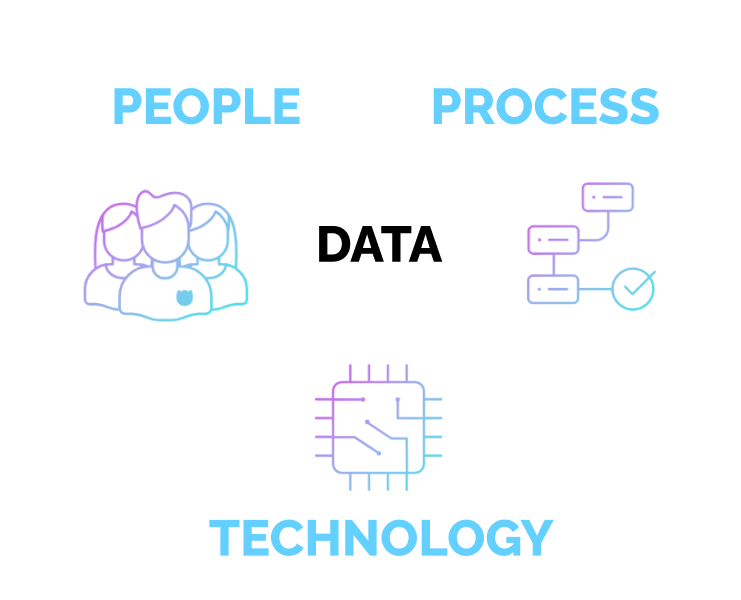
Sustainable progress extends beyond technology. It requires alignment of people, processes, accountability, and execution models. Organizations that institutionalize discipline convert transformation into long-term advantage.
Cultural Alignment and Operating Model
Data initiatives often fail when responsibility is ambiguous.
Sustainable progress requires a clear operating model that defines who owns data, who maintains it, and who is accountable for outcomes. Data domains, stewardship roles, and governance structures create the clarity required for teams to operate effectively.
Leadership also plays a critical role. Executives must reinforce data-driven decision making, encourage transparency, and hold teams accountable for using reliable information.
When culture and operating structure reinforce each other, data becomes part of daily decision making rather than an isolated initiative.
"Data becomes strategic the moment someone is accountable for it."

Continuous Improvement Loop
Data transformation is not a one-time project. It is an ongoing capability.
As the organization evolves, new systems emerge, regulations change, and analytical needs expand. Continuous improvement ensures that data strategy, architecture, and governance evolve alongside the business.
Organizations that succeed establish feedback loops that monitor performance, identify gaps, and refine the roadmap. Metrics are reviewed regularly. Priorities are reassessed. Architecture evolves as new capabilities become necessary.
This discipline allows organizations to stay aligned with strategy while adapting to change.
| Demand | Execution Model |
|---|---|
| Strategic direction needed | Fractional leadership |
| Platform development | Specialized engineering |
| Analytics delivery | Embedded experts |
| Program acceleration | Scalable delivery teams |
Flexible Execution Models
Many organizations struggle to sustain progress because they lack the specialized expertise required to maintain complex data ecosystems.
Flexible execution models solve this challenge by allowing organizations to scale expertise as needed. Fractional leadership, specialized engineering teams, and embedded data experts provide the skills required to accelerate initiatives without permanently expanding internal teams.
This approach allows organizations to maintain momentum while adapting to changing priorities and resource constraints.
Execution becomes scalable, not constrained by organizational structure.
"The pace of transformation often depends on access to the right expertise at the right time."

Risk & Resilience at Scale
As organizations scale their data capabilities, risk management becomes increasingly important.
Mergers and acquisitions introduce new systems and governance challenges. Regulatory environments evolve. Cybersecurity threats become more sophisticated. Data platforms must be resilient enough to handle these pressures while continuing to deliver reliable insight.
Resilient organizations design their data environments with these realities in mind. Governance frameworks adapt to regulatory change. Integration strategies support rapid consolidation of acquired systems. Security practices evolve alongside the threat landscape.
Resilience ensures that growth does not compromise trust.
Putting it all Together
You now have the framework required to turn data from an operational challenge into a strategic capability.
Organizations that succeed do four things consistently:
They build trusted foundations through governance and ownership.
They modernize architecture so systems scale with demand.
They enable analytics that drive real decisions.
They operationalize AI responsibly and at scale.
When these elements align, data stops being fragmented and begins driving measurable performance.
The final step is execution.
Next Step
Every organization’s data journey is different. The fastest way to accelerate progress is to evaluate your current environment honestly and identify where the biggest opportunities exist.
Our team works with enterprise leaders to assess data foundations, prioritize high-impact initiatives, and build the roadmap required to move from strategy to execution.
Data Strategy Session
Turn Your Data Strategy Into an Execution Plan
Meet with our data and AI leaders to evaluate your current environment, identify high-impact opportunities, and define the next steps for building a scalable data foundation.