What Is Actually Holding Us Back?
Foundational Gaps and Structural Exposure.
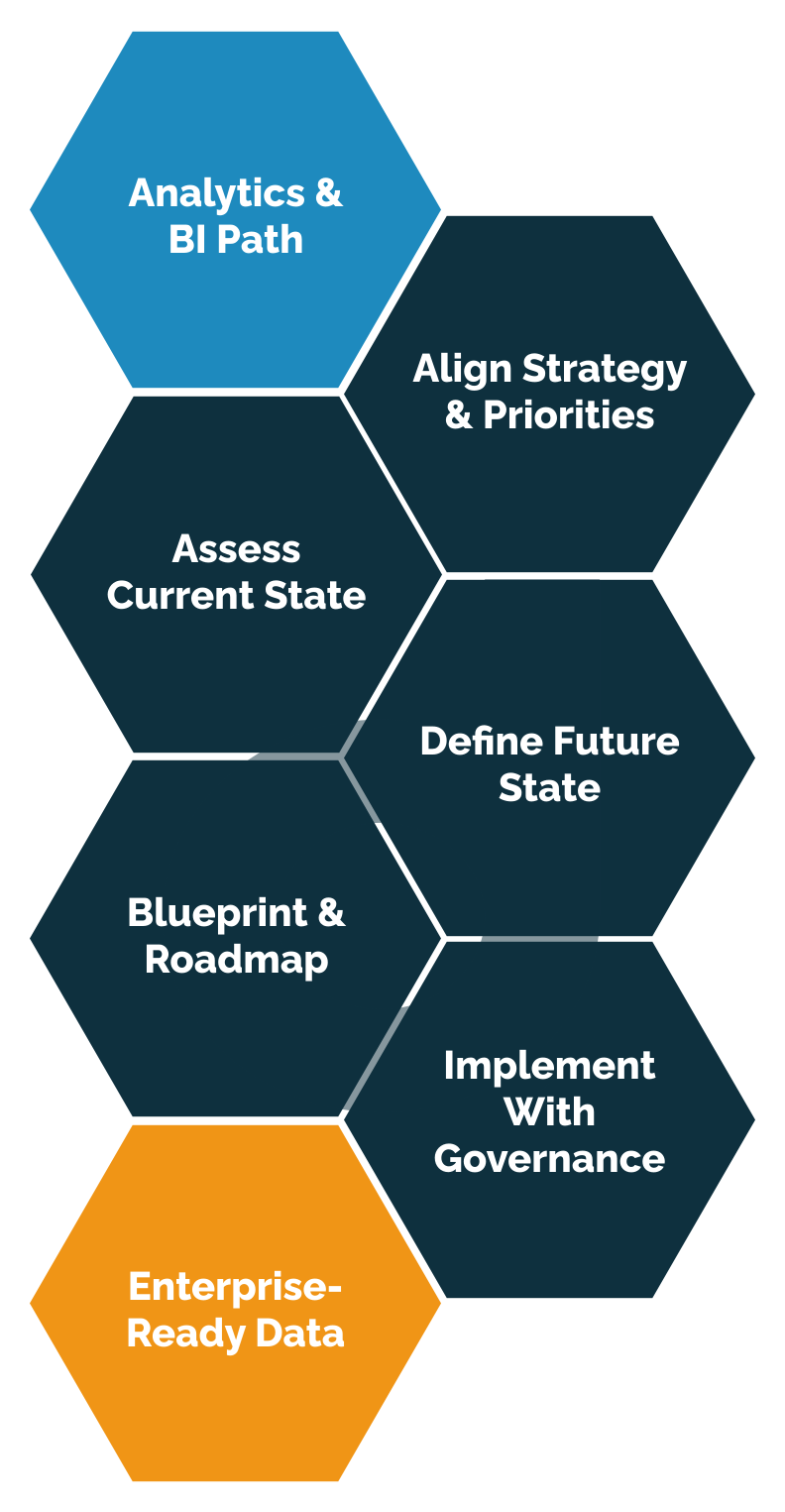
Before you accelerate analytics, AI, or modernization efforts, diagnose where fragmentation, trust erosion, governance weakness, and premature AI pressure are quietly constraining progress. Most initiatives stall not because of ambition, but because structural weaknesses go unaddressed.
Try Our Data Maturity Assessment
Get a view into where your organization stands today and what it would take to move toward a more modern, scalable, and AI-ready data ecosystem.
Fragmentation
Fragmentation rarely announces itself.
It arrives quietly — through expansion, acquisition, modernization efforts, and well-intentioned autonomy across departments. Each decision makes sense in isolation. Over time, however, those decisions accumulate into a structural problem.
Data begins to reside in multiple platforms. Definitions evolve independently. Pipelines are built to solve local needs rather than enterprise alignment.
What emerges is not dysfunction – it is misalignment.
The organization can still produce reports. Dashboards still load. Teams still operate. But beneath the surface, effort increases. Integration slows. Trust becomes conditional.
Fragmentation is not the absence of data. It is the absence of cohesion. And cohesion is what enables scale.
When architecture is fragmented, every new initiative — analytics, automation, AI — requires reconciliation before acceleration. Each acquisition introduces new silos. Each transformation project becomes partially a cleanup exercise.
The enterprise moves forward. But with friction.
That friction compounds quietly, quarter after quarter.
Trust & Quality
Data quality is rarely questioned when dashboards are green. It is questioned when numbers conflict, when forecasts miss, or when leaders hesitate before acting.
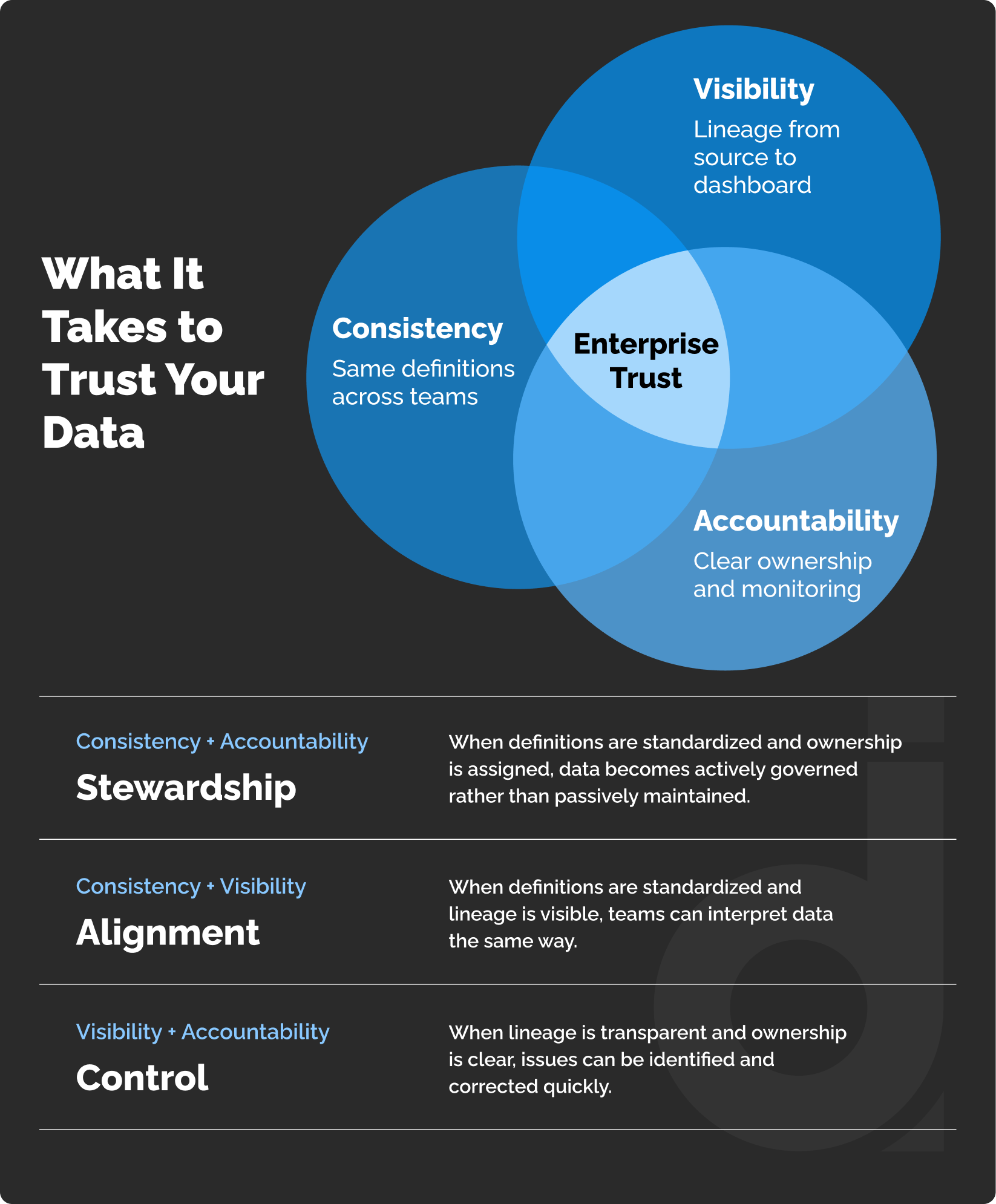
Trust is not created by volume. It is created by consistency, clarity, and accountability.
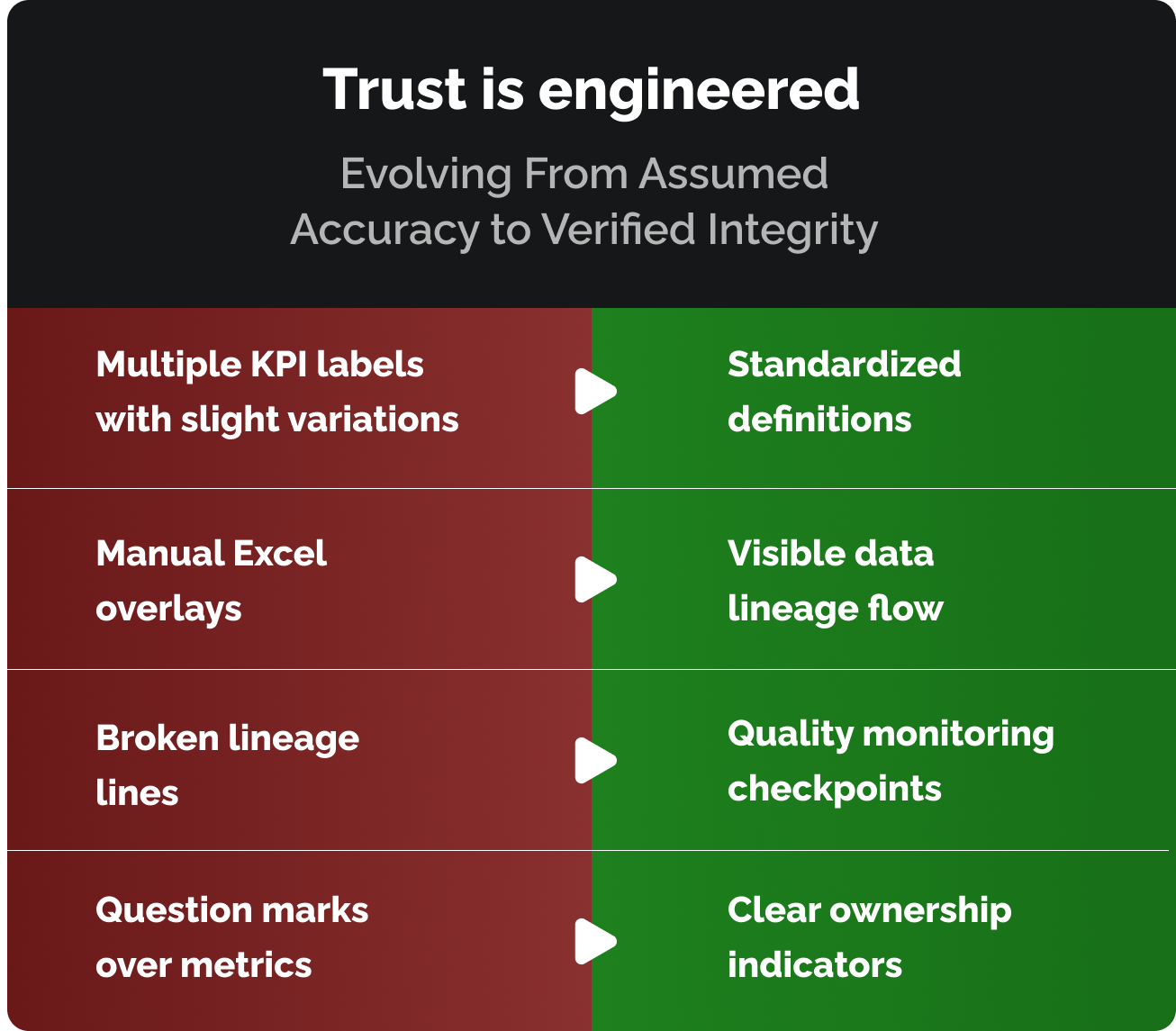
Many organizations assume quality because systems are operational. Yet operational systems do not guarantee accurate, consistent, or governed data. Definitions drift. Metrics evolve. Manual overrides become normalized. Over time, subtle inconsistencies accumulate.
The consequence is not always visible. Meetings slow. Debates shift from strategy to validation. Executives request parallel reports. Teams build shadow spreadsheets “just to be sure.”
Trust does not collapse suddenly. It degrades gradually. And once degraded, adoption follows.
Analytics adoption declines when confidence declines. AI initiatives stall when data integrity is uncertain. Automation becomes risky when inputs are unstable. Without trust, data remains informational. It does not become strategic.
The transition from data-informed to data-driven requires one thing above all else: confidence that the numbers are correct, complete, and consistent across the enterprise.
Governance & Risk
As organizations scale, data becomes more than an operational asset. It becomes a regulated, exposed, and reputational liability.
- Growth increases complexity.
- Complexity increases surface area.
- Surface area increases risk.
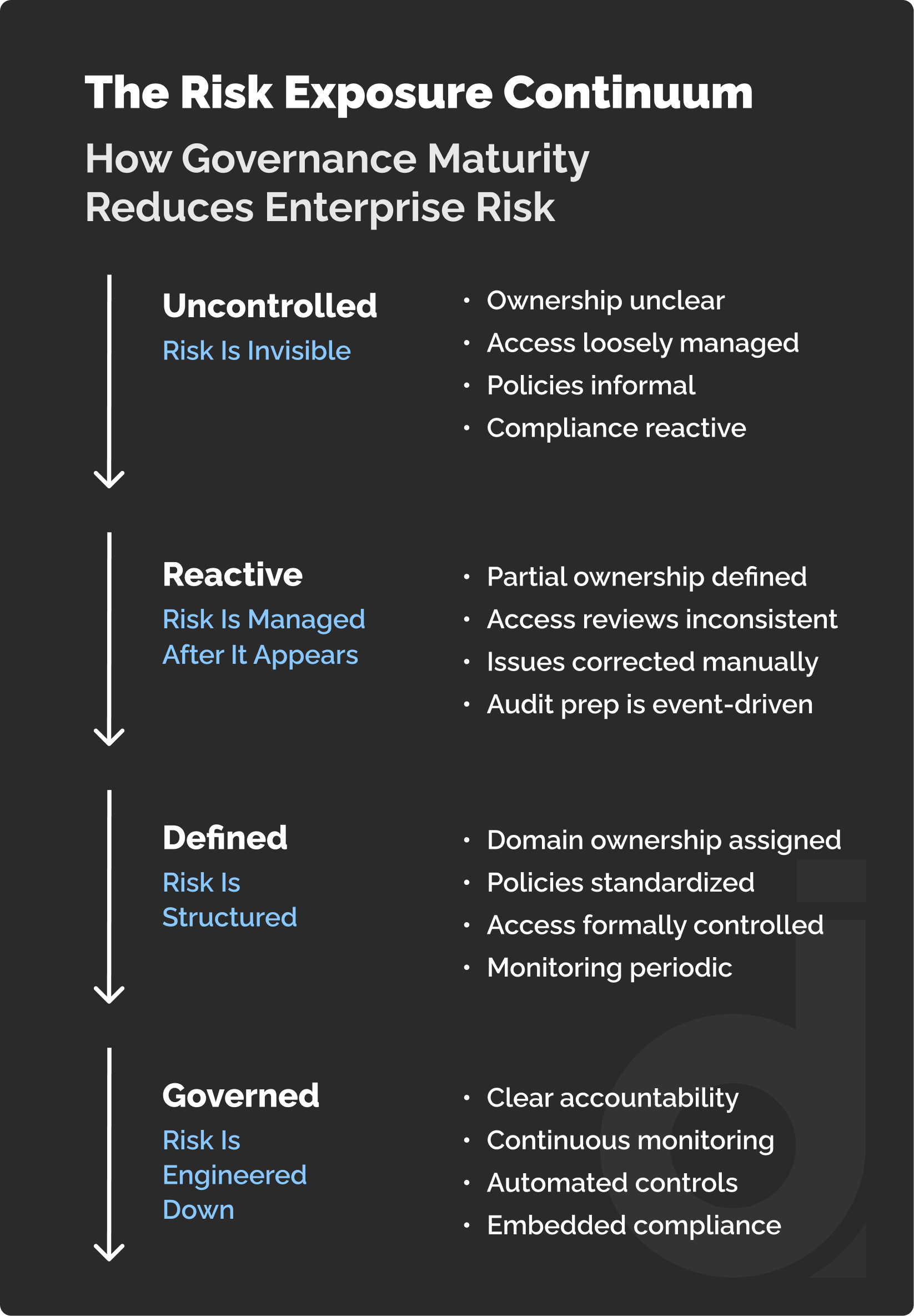
Without formal governance, standards drift. Access expands informally. Sensitive information spreads beyond its intended boundaries. Reporting obligations become reactive exercises instead of controlled processes. Risk rarely appears as a dramatic failure at first.
It appears as:
- Unclear data ownership.
- Inconsistent policies across departments.
- Access granted without structured review.
- Third-party integrations without full visibility.
- Audit findings that require remediation under time pressure.
Governance is often misunderstood as documentation and policy. In reality, it is structural discipline. It defines who owns what. It defines how data is classified. It defines how quality is monitored. It defines how compliance is maintained.
Without governance, control is assumed. With governance, control is engineered. In a modern enterprise, data governance is not optional infrastructure. It is executive risk management.
Intelligence Readiness
Many organizations view artificial intelligence as the next logical step in their data journey. The pressure is understandable. Competitors are experimenting. Vendors are accelerating. Boards are asking questions. But intelligence does not replace foundation. It exposes it.
AI systems depend on:
- Clean inputs.
- Consistent definitions.
- Accessible, integrated data.
- Clear governance and accountability.
When those elements are weak, AI does not fail dramatically. It underperforms quietly. Predictions lack reliability. Automation introduces risk. Insights generate hesitation rather than confidence. Intelligence readiness is not about model selection or vendor choice. It is about structural maturity.
An enterprise is ready for AI when:
- Data is trusted across departments.
- Architecture supports scale.
- Governance is embedded.
- Analytics adoption already exists.
AI is not the starting point of transformation. It is the acceleration layer built on disciplined data infrastructure. Without readiness, AI becomes experimentation. With readiness, AI becomes advantage.