What is a Modern Data Architecture
A Practical Executive Guide


MIKE SARGO
CDO & Co-Founder
Helping organizations align business and data strategy since 2017.
Most organizations don’t struggle with data because they lack technology. They struggle because their data environment was never designed to scale with the business.
Over time, well-intentioned decisions accumulate. Pipelines are added. Definitions drift. Governance becomes reactive. What started as a flexible system slowly turns fragile—harder to trust, harder to change, and harder to explain under pressure.
This guide is meant to reset that foundation. Not by introducing new tools or abstract frameworks, but by clarifying how modern data architecture should be designed, governed, and operated in the real world.
A Modern Data Architecture exists to solve one core issue:
how data moves from raw inputs to trusted decisions—at scale, with accountability.
A Modern Data Architecture is not a product you buy.
It is a system you design and operate.
What This Guide Is
- A practical blueprint for building a scalable, governed, AI-ready data foundation
- Focused on outcomes, not tools
- Designed for executive leaders and data decision-makers
- Grounded in patterns that work across industries and platforms
What This Guide Is Not
- A cloud migration plan
- A vendor comparison
- A reference architecture diagram without context
- A theoretical or academic framework
CHAPTER 1
Why Modern Data Architecture Exists
Most organizations already have the technology they need.
What they lack is the architecture, operating model, and discipline required to turn data into a reliable business asset.
“Speed, governance, AI, and compliance all pull data in different directions. Modern architecture is how you stop trading one problem for another.”
Mike Sargo
CDO & Co-Founder

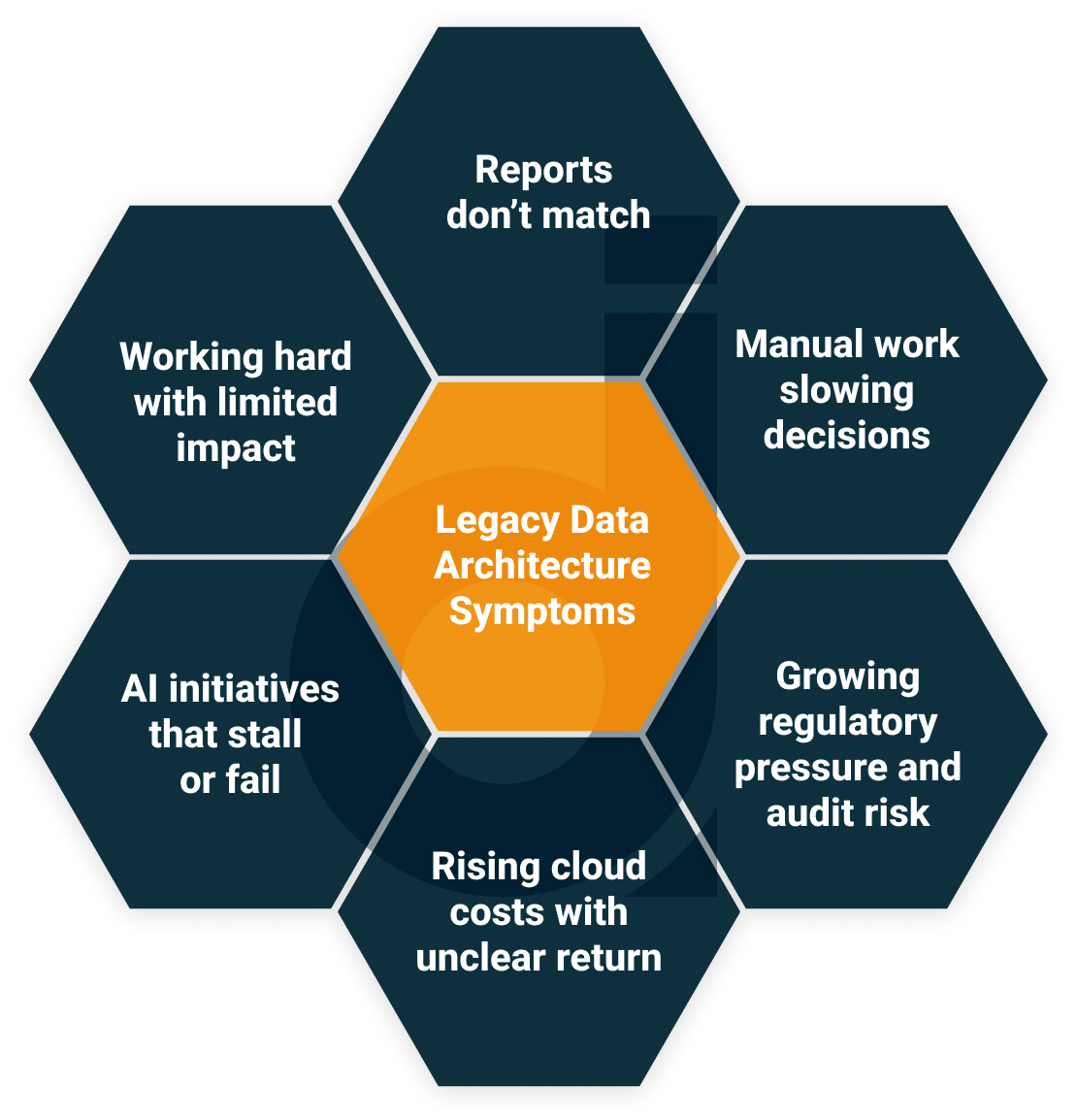
Executives Experience the Symptoms of Legacy Data Architecture Everyday
These symptoms show up long before an architecture is ever discussed. Reports stop lining up. Decisions slow down. Teams work harder, but outcomes don’t improve.
What looks like a talent, tooling, or process problem is usually structural. Legacy architectures were never designed to support today’s scale, regulatory pressure, or AI-driven use cases.
Over time, the gaps compound—creating cost, risk, and frustration across the organization.
Modernization Is No Longer Optional
These requirements didn’t appear overnight.
They emerged as organizations became faster, more regulated, more automated, and more data-dependent.
The challenge is that each demand pulls the system in a different direction. Speed without governance creates risk. Consistency without ownership creates debate.
AI without explainability creates exposure. Without a modern architecture to reconcile these forces, organizations end up trading one problem for another.
What Changes Upon Implementing A Modern Data Architecture
A Modern Data Architecture replaces fragile, siloed systems with a disciplined data lifecycle.
The result is not more data. The result is clarity, trust, and speed.
Legacy World
- Overnight batch ETL
- Single warehouse
- Manual reconciliation
- Disparate KPIs
- AI experiments
Modern World
- Near real-time ingestion
- Scalable lakehouse
- Automated quality & lineage
- Certified, consistent metrics
- AI-ready foundation
CHAPTER 2
What Is a Modern Data Architecture?
A Modern Data Architecture (MDA) is the blueprint for how an organization collects, governs, transforms, and activates data for analytics, operations, and AI.
It is not a tool. It is not a cloud migration. It is not a diagram.
It is the system that makes everything else work.
Organizations with a modern architecture can trust their data, move faster, and scale analytics without chaos. Organizations without one spend their time reconciling numbers, firefighting pipelines, and debating whose report is “right.”
“Modern data architecture isn’t about new technology. It’s about enforcing trust, ownership, and standards at the moments when the business can’t afford ambiguity.”
Mike Sargo
CDO & Co-Founder
What Modern Data Architecture Actually Solves
In practice, architecture exists to remove ambiguity when decisions matter.
These questions surface under pressure — during audits, executive reviews, AI initiatives, and incidents. When the answers aren’t clear, consistent, and defensible, the architecture is failing.
| The five hard questions: | What answers them: |
|---|---|
| Can we trust this number? | Certified metrics & quality rules |
| Can we explain how it was calculated? | Lineage & reproducibility |
| Can we respond faster without breaking governance? | Embedded governance |
| Can we scale analytics without scaling headcount? | Scalable lakehouse & automation |
| Can AI use this data safely and reliably? | AI-ready data lifecycle |
Core Characteristics of a Modern Data Architecture
A Modern Data Architecture is designed for how businesses operate today, not how data teams worked ten years ago.
These are not “nice to haves.” They are table stakes for modern decision-making.

Executive Reality Check
Most organizations already own the platforms required to do this. What they don’t have is:
- a data lifecycle that holds from ingestion to insight
- ownership that’s explicit and accountable
- standards that are enforced, not optional
- an operating model that keeps things from drifting
What Changes When Architecture Is Done Right
When architecture is done right, it fades into the background.
Teams stop arguing about numbers and start acting on them. Data flows predictably from source to decision, with clear ownership, built-in controls, and room to scale. Instead of reacting to issues after the fact, the organization can see problems early and address them before they compound.
Architecture doesn’t create value on its own. It creates the conditions where value can be delivered consistently.
- KPIs match across teams
- AI initiatives move from experiments to production
- Data quality issues are visible and addressable
- Governance supports speed instead of slowing it down
- Analytics teams spend time delivering value, not fixing pipelines
CHAPTER 3
Why Modernize? The Business Drivers
Organizations modernize their data architecture for one reason: The old model no longer supports how the business operates.
Legacy architectures were built for static reporting, centralized teams, and delayed decision-making. Today’s environment demands speed, consistency, accountability, and scale — and legacy systems break under that pressure.
“Real-time decisions, AI, and compliance aren’t separate challenges. They all depend on the same thing: an architecture built to operate under pressure.”
Mike Sargo
CDO & Co-Founder
The Top Business Drivers Requiring Data Modernization
Modernization is not driven by technology trends. It is driven by business reality.
Real-Time Decisions Are Now Table Stakes
Waiting 24 hours for data used to be acceptable. It isn’t anymore.
Whether it’s clinical intervention, fraud detection, supply chain adjustments, or customer experience, businesses are expected to respond as events happen, not after the fact.
If your architecture updates overnight, you’re operating behind the business — and your competitors.
Modern architectures support batch, micro-batch, and streaming without redesigning the platform every time the business needs speed.
AI Fails Without a Strong Data Foundation
Most AI initiatives don’t fail because of models. They fail because of data.
AI cannot succeed when:
- keys are inconsistent
- data is duplicated or missing
- metrics aren’t defined
- lineage doesn’t exist
- features can’t be reproduced
- data changes without detection or control
A modern architecture provides:
- trusted, conformed datasets
- consistent feature engineering
- full lineage and traceability
- governance that satisfies risk and compliance
- clear ownership and accountability
- reliable data pipelines that scale without rework
AI doesn’t fix bad data. Architecture does.
Compliance and Audit Pressure Keep Increasing
Regulators don’t care how complex your systems are. They expect:
- explainable metrics
- traceable data flows
- controlled access
- documented definitions
- enforceable retention policies
Modern architectures embed governance into every layer, making compliance repeatable instead of reactive.
Organizations without this foundation spend more time preparing for audits than running the business.
Cloud Cost Without Architecture Is Waste
Cloud platforms are powerful — and expensive when misused. Without a modern architecture:
- transformations run redundantly
- compute is over-provisioned
- pipelines sprawl
- ownership is unclear
- cost optimization becomes guesswork
Modern architectures isolate workloads, scale intelligently, and shift processing to the right layer. The result is predictable cost and measurable return.
Most organizations see meaningful cost improvement after modernization — not by cutting usage, but by using the platform correctly.
Business Alignment Breaks Without Architectural Discipline
Nothing erodes trust faster than mismatched numbers.
When teams argue about whose report is right, the issue is rarely the dashboard. It’s the architecture behind it.
Modern architecture enforces:
- shared definitions
- certified metrics
- domain ownership
- consistent consumption
Alignment turns data from overhead into a decision-making asset.
The Bottom Line
Organizations don’t modernize because it’s interesting. They modernize because it drives business results.
Modern Data Architecture is the foundation that allows all of these to coexist.
CHAPTER 4
The Architecture Blueprint:
Raw → Silver → Gold
Most modern data platforms fail for one simple reason: There is no discipline in how data moves from ingestion to decision-making.
The most effective pattern in use today — across healthcare, financial services, and mid-market organizations — is a Lakehouse architecture with a Raw → Silver → Gold lifecycle.
This approach creates clarity, enforces accountability, and prevents downstream chaos.
“Every data architecture has to answer three questions: Can we prove it, can we trust it, and can the business act on it? Raw, Silver, and Gold exist to answer those—without shortcuts.”
Mike Sargo
CDO & Co-Founder
Why This Model Works
Raw → Silver → Gold is not about layers for the sake of structure. It exists to answer three fundamental questions:
Each layer exists for a specific reason — and skipping one breaks the system.

Bronze ( Raw ):
Fidelity and Auditability
Raw data preserves exactly what the source system provided. No transformations. No assumptions. No shortcuts.
Raw includes:
- original schema
- timestamps and change history
- unmodified payloads
- full record versions
Bronze Executive Intent
Raw exists to protect the organization.
It enables replay, recovery, audit defense, and AI training lineage. Without Raw, every downstream correction requires re-ingestion — increasing risk, cost, and ambiguity.
If you can’t point to Raw, you can’t prove anything.

Silver:
Standardized, Trusted Enterprise Data
Silver is where data becomes reliable. This layer introduces:
Raw includes:
- reference data alignment
- schema standardization
- conformed dimensions
- deduplication
- baseline quality rules
- anomaly detection
Silver Executive Intent
Silver exists to create trust.
It is the enterprise consistency layer that prevents teams from arguing over numbers. If Silver is wrong, everything downstream collapses — no matter how good the dashboards look.
Most data failures happen here, not in dashboards or tools.

Gold:
Business-Ready, Outcome-Aligned Data
Gold is where architecture turns into business value. This layer delivers:
Raw includes:
- near-real-time wide tables
- KPI-ready datasets
- domain-specific facts & dimensions
- aggregated reporting tables
- machine learning feature sets
- curated semantic layers
Gold Executive Intent
Gold exists to drive decisions.
Revenue, cost, risk, customer experience, and operational performance all live here. If Gold is disconnected from business ownership, analytics becomes overhead instead of advantage.
Gold datasets are owned by the business, aligned to outcomes, governed and certified.
What This Model Prevents
Discipline at the architectural level eliminates firefighting downstream.
Multiple versions of the same KPI across teams
Small upstream changes breaking downstream reporting
No clear accountability when data quality issues surface
Business rules recreated in dashboards instead of data models
Continually backfilling, reprocessing, and manual fixes
This Model Is Platform Agnostic
This architecture works across all major cloud data platforms because it is built on principles, not products.
Raw → Silver → Gold enforces a consistent data lifecycle that every modern platform supports — regardless of vendor.
Storage, compute, transformation, and governance are available everywhere. Discipline is not.
The platform matters far less than how it is used.
Most organizations don’t need architectural complexity. They need consistency, ownership, and enforcement.





CHAPTER 5
A Reference Architecture That Actually Works
Most organizations don’t fail because their data architecture is too simple. They fail because it’s over-engineered, inconsistently applied, or never fully adopted.
The reference architecture below works for the majority of enterprises because it prioritizes clarity, governance, and scalability — without unnecessary complexity.
“Good architecture removes ambiguity. Great architecture resists unnecessary complexity. You earn sophistication over time—by operating the fundamentals well first.”
Mike Sargo
CDO & Co-Founder
Design Principle: Simple, Disciplined, Scalable
A modern data architecture should:
- Scale without redesign.
- Support analytics, operations & AI.
- Enforce governance by default.
- Adapt to use cases without chaos.
Cloud Lakehouse for Unified Storage and Compute
A lakehouse provides a single platform for:
- structured, semi-structured, and unstructured data
- SQL, analytics, and machine learning
- scalable storage and elastic compute
This eliminates the fragmentation caused by separate warehouses, data lakes, and analytics silos.
Key outcome:
One platform. One security model. One governance surface.
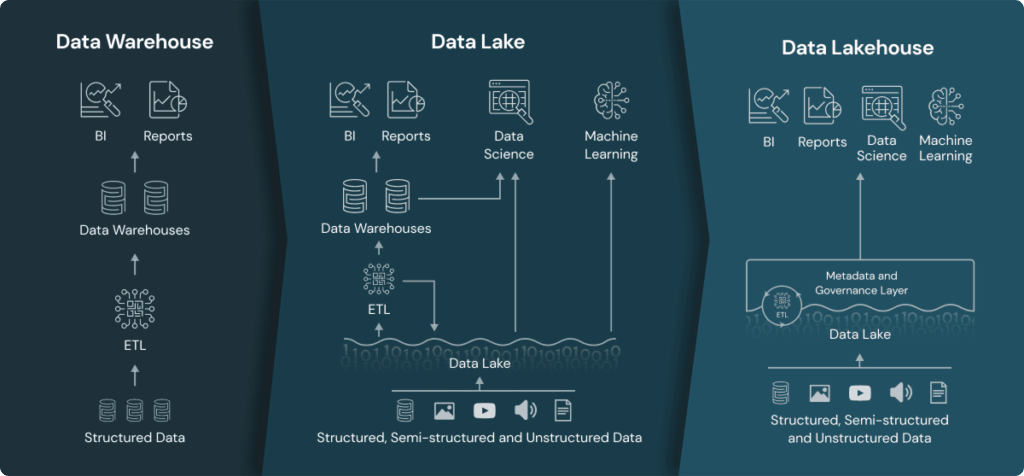
Image courtesy of Databricks.
Medallion Lifecycle for Data Transformation
Raw → Silver → Gold is the backbone of the architecture. This lifecycle ensures:
- predictable data flow
- consistent modeling patterns
- easier onboarding of new sources
- enforceable quality standards
It removes ambiguity around where data should live, how it should be transformed, and who owns it.
Key outcome:
Discipline replaces tribal knowledge.
Standardized Ingestion Layer
Ingestion must support the reality of modern data:
- batch
- streaming
- change data capture (CDC)
- event-driven / near-real-time feeds
A strong ingestion layer includes:
- managed connectors
- schema drift handling
- metadata capture
- classification at ingestion
Key outcome:
Data arrives consistently and predictably — not creatively.
Governance Embedded at Every Layer
Governance is not a separate system.
It must be embedded across:
- ingestion
- storage
- transformation
- consumption
This includes:
- lineage
- metadata management
- KPI definitions
- role- and attribute-based access
- data quality rules
- certification workflows
Key outcome:
Trust is built in, not negotiated later.
Consumption and Interoperability Layer
Modern architectures must support multiple consumers:
- BI tools
- operational applications
- APIs
- feature stores
- data sharing and reverse ETL
This layer ensures data products can be used where decisions actually happen, not just in dashboards.
Key outcome:
Analytics moves closer to operations.
Optional Enhancements — Only When Justified
Not every organization needs advanced architectural patterns. These should be introduced only when maturity and use cases demand it:
- Data Mesh — when domains are ready for ownership and accountability
- Data Fabric — when metadata automation across platforms is required
- Hub-and-Spoke — for distribution-heavy environments
- Lambda/Kappa — for true millisecond-level latency
- Virtualization — for M&A or transitional integration scenarios
Adding these too early increases cost and failure risk.
A Hard Truth
Most organizations succeed by doing fewer things well.
The reference architecture works because it:
- is repeatable
- is governable
- scales with the business
- avoids unnecessary customization
Complexity should be earned — not assumed.
CHAPTER 6
Governance & Security: The Backbone of Modern Data
Without governance, you don’t have analytics. You have chaos.
Governance is what allows data to be trusted, shared, automated, and used safely at scale. Organizations that treat governance as an afterthought pay for it later — in rework, audit risk, and stalled initiatives.
Modern governance is not about control. It’s about confidence.
“Governance isn’t something you manage after the fact. It’s something you design into the architecture so trust, security, and speed can coexist.”
Mike Sargo
CDO & Co-Founder
Governance Must Operate at Every Layer
Governance is only effective when it is applied through the entire data lifecycle, not bolted on at the end.
Raw Layer Governance:
Data Truth
At the Raw layer, governance exists to preserve fidelity and auditability. This includes:
- schema drift detection
- data versioning
- PII identification and tagging
- restricted access controls
- retention and archival policies
Business outcome:
You can prove what the source provided — every time. This is non-negotiable for regulatory defense and AI traceability.
Silver Layer Governance:
Data Trust
Silver is where governance protects the enterprise from inconsistency. This layer enforces:
- data quality scoring
- conformed dimensions
- baseline validation rules
- error handling and remediation
- standardized definitions
Business outcome:
Teams stop arguing about numbers. Trust is built here — or lost permanently.
Gold Layer Governance:
Data Meaning
At the Gold layer, governance ensures data is used correctly. This layer enforces:
- KPI certification
- metric versioning
- domain ownership
- semantic layer integration
- business glossary alignment
Business outcome:
Executives know which numbers matter — and why.
Security Is Not Separate From Governance
Security must be designed into the architecture, not layered on later. Security failures don’t come from missing tools. They come from missing discipline.
Modern data security requires:
- zero-trust identity
- column- and row-level security
- role- and attribute-based access
- encryption at rest and in transit
- audit logging and monitoring
- policy-driven data access & enforcement
Governance Enables Speed
This is where most organizations get it wrong.
Strong governance:
- reduces rework
- accelerates onboarding
- enables automation
- supports self-service analytics
- lowers risk without slowing teams
Weak governance forces manual review, exception handling, and constant negotiation. Governance is the difference between scaling analytics and scaling problems.
A Reality Check
If governance is perceived as friction, the architecture is incomplete.
When governance is embedded correctly:
- speed increases
- trust improves
- compliance becomes repeatable
- AI initiatives move forward safely
That’s not theory. That’s execution.
CHAPTER 7
DataOps & the Operating Model: How Modern Architecture Actually Runs
Modern data architecture does not succeed because of tools. It succeeds because of how it is operated.
Organizations that modernize platforms without changing their operating model simply move old problems to a new environment — faster and more expensively.
DataOps is not a role. It is not a tool.
It is the discipline that keeps the system working.
“DataOps isn’t a tool or a team. It’s the discipline that keeps quality high, costs predictable, and delivery moving when the system is under pressure.”
Mike Sargo
CDO & Co-Founder
The Four Functions Every Modern Data Organization Needs
Regardless of size or industry, successful data organizations consistently operate across four core functions. When any one is missing, the system degrades.
Platform Operations
This function keeps the architecture stable, performant, and cost-efficient.
Responsibilities include:
- ingestion reliability
- orchestration and scheduling
- pipeline observability
- workload management
- identity and access controls
- cost optimization (FinOps)
Business outcome:
The platform runs predictably and efficiently. When this function is weak, teams spend their time firefighting instead of delivering value.
Data Product Delivery
This is where data becomes usable by the business.
Responsibilities include:
- Gold layer modeling
- KPI and metric definitions
- semantic layer development
- feature engineering for AI
- domain-aligned data products
Ownership matters here. Data products must be tied to business domains — not centralized reporting teams disconnected from outcomes.
Business outcome:
Analytics aligns directly to how the business operates.
Governance & Risk
This function ensures trust, compliance, and accountability.
Responsibilities include:
- data stewardship
- quality SLAs
- lineage management
- audit readiness
- privacy and regulatory controls
Governance without operational integration becomes policy. Governance with ownership becomes protection.
Business outcome:
Risk is controlled without slowing delivery.
Business Enablement
Adoption does not happen automatically.
Responsibilities include:
- BI and analytics training
- KPI alignment across teams
- communication of new datasets and metrics
- user support and enablement
Without this function, even high-quality data goes unused.
Business outcome:
Insights are adopted, not ignored.
What Happens When the Operating Model Is Undefined
Organizations without a clear operating model experience:
- unclear ownership
- slow delivery
- inconsistent metrics
- governance drift
- duplicated effort
- frustrated business teams
These are not technology failures. They are operational failures.
A Practical Truth
You don’t need a large team to run a modern architecture.
You need clear roles, accountability, and cadence.
When the operating model is right:
- delivery accelerates
- quality improves
- cost stabilizes
- trust compounds
That’s when architecture becomes a business capability — not a project.
CHAPTER 8
AI Readiness: Where Most Organizations Get It Wrong
Most organizations don't fail at AI because the models are bad. They fail because the data foundation isn't ready.
AI exposes weaknesses in architecture faster than any other initiative. Inconsistent data, unclear metrics, missing lineage, and weak governance don't slow AI down — they stop it entirely.
AI readiness is not an aspiration.
It is an architectural condition.
“AI doesn’t introduce new data problems. It exposes the ones you’ve been living with—faster and at a much larger scale.”
Mike Sargo
CDO & Co-Founder
What AI Actually Requires
For AI and machine learning to operate reliably, the following must already exist
-
High-quality, trusted data
Data must be conformed, validated, and consistent across domains.
-
Clear metric definitions
Models trained on ambiguous KPIs produce ambiguous results.
-
Operational monitoring
Data must be conformed, validated, and consistent across domains.
-
Lineage and traceability
Every model output must be explainable — especially in regulated environments.
-
Reproducible feature engineering
Features must be versioned, documented, and repeatable.
-
Governance that satisfies risk and compliance
AI increases scrutiny. Architecture must absorb that pressure.
If these conditions aren't met, AI becomes a science experiment instead of a business capability.
AI Does Not Fix Data Problems
This needs to be stated clearly. AI will not:
- clean inconsistent data
- reconcile conflicting metrics
- resolve ownership gaps
- replace governance discipline
In fact, AI amplifies data issues — faster and at greater scale. Organizations that succeed with AI treat it as the next layer on top of a disciplined architecture, not a shortcut around it.
Executive Reality Check
AI initiatives that succeed share one trait:
They were built on architectures designed for trust, scale, and explainability. Organizations chasing AI before addressing data foundations often burn budget, lose credibility, and slow future progress.
AI readiness is not about speed to demo.
It’s about speed to durable value.
Generative AI and RAG: The Same Rules Apply
Generative AI introduces new capabilities — but not new fundamentals.
To support GenAI and retrieval-augmented generation (RAG), organizations still need:
- curated Gold-layer inputs
- embeddings created from trusted content
- vector databases with access controls
- governed prompt management
- secure context retrieval
If the underlying data is untrusted, GenAI simply produces untrusted answers — more confidently.
The Bottom Line
AI is not the starting point.
It is the reward for doing architecture, governance, and operations correctly.
When the foundation is solid:
- AI accelerates insight
- automation scales safely
- decision-making improves
- risk remains controlled
When it isn’t, AI magnifies failure.
CHAPTER 9
KPI Governance: Eliminating the “Whose Number Is Right?” Problem
Nothing destroys confidence in data faster than inconsistent metrics.
When teams argue about numbers, decision-making slows, trust erodes, and data initiatives lose credibility. The issue is rarely the dashboard — it’s the lack of metric governance behind it.
KPI governance is not bureaucracy.
It is how organizations establish a single, trusted view of performance.
“If teams are debating whose number is right, the architecture has already failed. KPI governance exists to eliminate debate and enable decisions.”
Mike Sargo
CDO & Co-Founder
What KPI Governance Enforces
Effective KPI governance ensures that every critical metric has:
- one agreed-upon definition
- one calculation logic
- one certified dataset
- one semantic layer
- clear ownership
- version control
When these are missing, metrics drift — quietly at first, then visibly.
Where KPI Governance Lives
KPI governance belongs in the Gold layer, supported by:
- standardized definitions
- certified data products
- semantic modeling
- documented business context
It must be enforced centrally, even when ownership is distributed.
Why This Matters to Executives
Executives don’t need more dashboards. They need confidence that the numbers are right.
Without KPI governance:
- teams build shadow logic in BI tools
- metrics diverge across departments
- debates replace decisions
- analytics loses authority
With KPI governance:
- alignment increases
- reporting accelerates
- accountability improves
- trust compounds
CHAPTER 10
Measuring Success: Proving the Architecture Delivers
A Modern Data Architecture is not successful because it exists. It’s successful because it produces measurable business outcomes.
Organizations that don’t define success upfront struggle to justify investment, prioritize improvements, or course-correct when things drift.
Success should be measured across three categories.
“Dashboards, pipelines, and models are activity. Success is when insight accelerates, manual effort disappears, and leaders trust what they see.”
Mike Sargo
CDO & Co-Founder
Platform Health Metrics
These metrics indicate whether the architecture is stable, performant, and cost-efficient.
Key Indicators:
- pipeline reliability and failure rates
- data freshness and latency
- query performance
- workload efficiency
- storage and compute utilization
- recovery time from failures
Executive Signal:
If the platform is unstable, everything built on top of it is at risk.
Data Trust Metrics
These metrics determine whether the organization can rely on the data it produces.
Key Indicators:
- data quality scores
- lineage completeness
- policy and access compliance
- KPI certification coverage
- consistency across reports and domains
Executive Signal:
If trust is low, adoption will stall — regardless of tooling.
Business Impact Metrics
This is where architecture proves its value.
Key Indicators:
- time-to-insight
- reduction in manual reporting effort
- automation enabled by data
- predictive model performance
- cost reduction
- improvements in revenue, risk, efficiency, or outcomes
Executive Signal:
If the business isn’t moving faster or making better decisions, the architecture isn’t done.
What Not to Measure
Avoid metrics that look good but don’t matter:
- number of dashboards
- number of data sources onboarded
- volume of data stored
- number of models built
Activity does not equal impact.
A Practical Reality
Early success should focus on stability and trust. Long-term success is measured in business outcomes.
Organizations that track all three categories gain clarity on:
- what’s working
- where to invest next
- what needs correction
That’s how architecture evolves instead of stagnates.
CHAPTER 11
From Chaos to Clarity
A Modern Data Architecture is not optional anymore.
It is the foundation required to operate with speed, confidence, and accountability in a data-driven world.
“Modern data architecture is how organizations move from fragility to leverage. It replaces chaos with systems that can be trusted, scaled, and defended.”
Mike Sargo
CDO & Co-Founder
What This Architecture Enables
When architecture, governance, and operating models are aligned, organizations gain:
- trusted analytics
- consistent metrics
- scalable data sharing
- operational automation
- AI and GenAI readiness
- regulatory confidence
- measurable business outcomes
These capabilities don’t emerge gradually. They compound.
A Final Reality Check
There is no shortcut to modern data maturity.
Organizations that skip steps or chase trends create fragility.
Organizations that invest in foundations create leverage.
Modern Data Architecture is not about perfection.
It’s about control, repeatability, and resilience.
Where to Focus Next
The most successful organizations:
- start with architecture, not tools
- embed governance early
- define ownership clearly
- operate with intent
- measure what matters
That’s how data becomes a capability — not a cost center.