• Solutions
        • STRATEGY & CONSULTING

        • Data & AI Strategy
        • Data Governance
        • Data Risk Management
        • Data Architecture
        • MODERNIZATION

        • Platform Modernization
        • Data Integration
        • Data Migration
        • Snowflake Implementation
        • DATA & AI

        • Data & AI Engineering
        • AI Enablement
        • Fractional Data Team
        • BI & Reporting
  • Technologies
        • Snowflake Elite Partner

          Delivering scalable data platforms, governed data pipelines, and AI-ready architectures for data-driven organizations.

  • Experience
        • MARKET EXPERIENCE

        • SUCCESS STORIES

        • Banking & Financial
        • Healthcare
        • Retail
        • Energy & Utilities
        • Construction and Manufacturing
        • Enterprise
        • Mid-Market
        • Private Equity
        • Building a Scalable Data Strategy from the Ground Up

          The client gained a clear path from fragmented systems to a modern data architecture, with a fully documented roadmap and business case.

        • Using AI to Streamline Home Construction Planning

          The client automated forecasting and prediction processes, saving time, reducing costs, and enabling smarter planning.

        • Explore More Success Stories
  • Company
        • Trusted experts in data, analytics, and AI enablement.

          Whether you’re modernizing your data platform, scaling AI, or building a governance foundation, we bring the right strategy, the right people, and the right pace to get it done right.

        • About
        • Leadership
        • Careers
  • Resources
        • Building A Right-Sized Data Strategy

          A practical framework for aligning data, governance, technology, and AI to business outcomes.


          View Data Strategy Guide
        • Realizing Business Value from Data & AI With Snowflake

          Whether your evaluating or scaling Snowflake, our guide can help you.


          View Our Snowflake Guide
        • Data & AI Governance for the Bank You’re Becoming

          Our interactive guide clarifies what you need as your bank scales.


          View Banking Governance Guide
  • Insights
        • ARTICLES & INSIGHTS

        • Data Strategy
        • Data Management
        • Data Science
        • Data Governance
        • Master Data Management
        • RESOURCES

        • Modern Data Architecture Guide
        • AI Readiness Assessment
        • Data & Analytics Infographics
        • C-Suite Data Answers
        • BUSINESS OBJECTIVES

          Adopt AI Improve Data Quality Eliminate Data Silos Ensure Security & Compliance Deliver Improved Analytics Enable Internal Teams
  • Talk To An Expert

Table of Contents

    Data Offense or Data Defense: Flexibility vs Control

    Data Offense or Data Defense: Flexibility vs Control

    Data-driven organizations understand that their data is a strategic asset and to properly harness its power it must be supported by a sophisticated data strategy.

    Having a strategy in place for your enterprise data allows organizations to properly manage its storage, ownership, and integrity. Implementing a strategy to your data journey eliminates silos and can improve areas such as decision-making, supply chain operations and monetization. However, in order for an organization to align their data strategy with business goals, key stakeholders must decide if they prefer a more data offense or data defense approach, flexibility vs control. But before that, let’s establish the primary difference of each approach.

    An offensive minded organization tend to be more business conscience and focus tactical and strategic outcomes to increase profitability, visibility, revenue, and customer satisfaction. They typically generate omnichannel customer insights utilizing data science mechanisms such as predictive analytics and leverage machine learning for automation that can forecast trends quicker. Data offense organizations are often ones that work with less regulator restrictions (i.e., retail). Therefore, tend to be more flexible with the use of its data and are more interested in multiple versions of the truth (MVOT).

    A defensive minded organization, customarily ones that operate in a highly regulated environment such as healthcare and financial services, lean toward a more technical plan of attack to minimize downside risks. Their activities usually include ensuring regulatory compliance through mandated governance initiatives that protect the integrity of data used for reports such as financial statements, employ business intelligence (BI) tools to alert personnel of suspected fraud, and support applications that prevent theft. Data defensive organizations put a premium on control by optimizing data extraction, standardization, and user access so that there is only a single source of truth (SSOT).

    Now, the challenge for key stakeholders within an organization is to determine the appropriate trade-offs between offense and defense and making sure those trade-offs support the company’s overall business goals. The more controlled data is, the easier it is to executive defensive actions that concern legal, financial and IT groups. The more offense ready data is, the more promptly available it is to be transformed for business needs. In an ideal situation striking a 50/50 balance would be optimal, but typically this would be ill-advised rather than deciding on strategic trade-offs. An organization’s data strategy should be informed by the industry, the data capabilities of competitors and the regulatory environment. Below is a graphic that illustrates where a company’s industry would generally fall under.
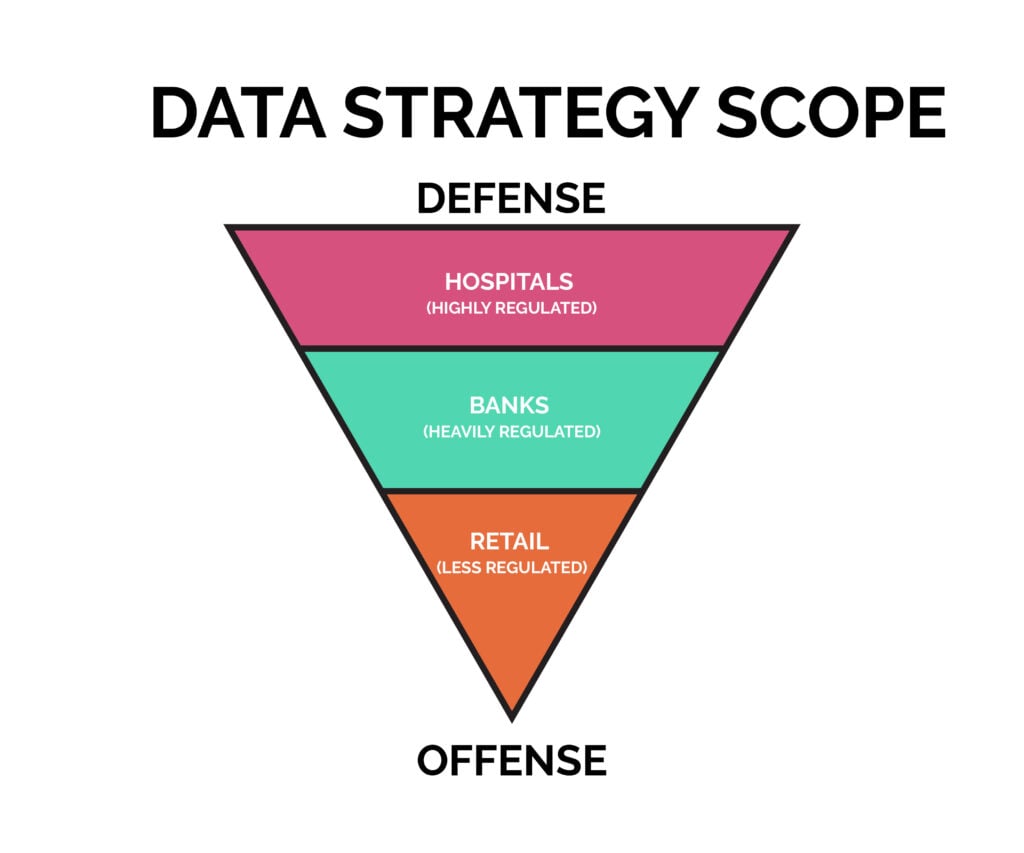
    data strategy scope triangle

    Regardless of the industry, a company’s stance on data offense and data defense (flexibility and control) is hardly static. While putting equal emphasis on each is ideal for some, for many it’s best to favor one or the other. And just because you started off preferring one position more than the other, doesn’t mean you are locked into that forever. Circumstances often change in the business world and a shift may be necessary. For example, due to increased competition in the market an insurer may decide to escalate its offensive activities. Or, because of more stringent regulations a hedge fund may need to alter its data strategy to focus on defense. Whatever the situation, Data Ideology is equipped with the industry knowledge and experience to accelerate data strategy initiatives that align with current organizational goals.


    Talk To A Data Expert

    Transform your data into business growth, innovation, and differentiation.

    Get Started Contact

    Explore More Insights

    1. Why do you need a Data Strategy now more than ever?
    2. Data Strategy Assessment: Current and Future State Analysis
    3. How to Build a Data Strategy Roadmap
    4. Enterprise Data Architecture Overview
    5. Navigating Your Data Journey with Data Ideology: Our Common Sense Framework

    Stay up to date on everything Data, Analytics & AI.

    Authors

    • Toby George

      Toby George

      Chief Revenue Officer & Co-Founder

    Browse Topics

    • AI Adoption
    • Data Architecture
    • Data Governance
    • Data Management
    • Data Science
    • Data Strategy
    • Master Data Management

    AI Use Cases

    • Hospital Resource Optimization
    • AI Data Strategy for Fraud Detection in Banking & Financial Institutions
    • AI Data Strategy for Intelligent Claims Denial Prediction in Health Payers & Healthcare
    • Real-Time Recommendation Engines
    • Personalized Financial Planning
    Data Ideology LinkedIn Data Ideology Twitter Data Ideology Youtube Data Ideology Facebook

    Women-Owned Business

    Privacy Policy

    Cookie Policy

    Website by Insivia, Tech Marketing Agency
    Snowflake Certified Partner
    Solutions
    • Data Strategy
    • AI Data Consulting
    • Data Risk Management
    • Data Governance
    • Data Engineering & Integration
    • Data Team-As-A-Service
    • Data Architecture
    • BI & Reporting
    Markets
    • Banking & Financial
    • Healthcare
    • Retail
    • Energy & Utilities
    • Construction & Manufacturing