FROM FRAGMENTED DATA TO TRUSTED DECISIONS

Your Reporting Is Only as Strong as the Data Behind It.

Finance, risk, compliance, and operations depend on many of the same records. When systems, definitions, and ownership do not line up, teams spend time reconciling numbers instead of understanding what they mean.

We help financial organizations solve foundational data challenges—building strategies that scale, securing sensitive data, and enabling trusted reporting across the enterprise.

Different reports tell different stories.

Disconnected source systems and inconsistent definitions make reporting harder to reconcile and explain.

Ownership and controls are difficult to trace.

Teams need a clear view of who owns the data, how it changes, and who can access it.

Manual work slows the next decision.

Spreadsheet handoffs and repeated data preparation leave less time to investigate exceptions and act.

PRACTICAL BANKING & FINANCE USE CASES

Start With the Decisions Your Teams Need to Make.

Choose a workflow to improve. Connect the information, definitions, and controls that make it useful.

FINANCE & REPORTING

Trusted Reporting & Reconciliation

Give teams a consistent view of the numbers behind their reports.

Connect source data, align business definitions, and introduce quality checks so finance and operations can investigate differences with a clearer view of the underlying records.

In practice

Trace a reporting exception to its source, identify the owner, and coordinate the next review.
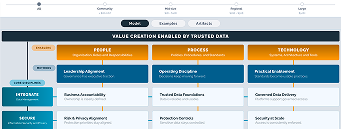
Explore the Governance Framework

RISK & COMPLIANCE

Governance & Audit Preparation

Make ownership, access, and data quality easier to explain.

Define responsibilities, document how information moves, and establish controls that help teams prepare evidence and address gaps in their data environment.

In practice

Review a critical dataset’s ownership, quality issues, and access controls before the next internal review.

Explore Governance Exposure

BANKING OPERATIONS

Banker Workflow & Lead Visibility

Put connected data back into the work your teams perform.

Bring current lead records, banker capacity, and branch assignments together to support lead distribution and a clearer view of activity and outcomes.

In practice

See how Data Ideology helped a large US bank streamline marketing lead data and automate distribution.

Explore the Bank Case Study

BANKING CASE STUDY

From Siloed Lead Data to a More Useful Banker Workflow

A large US bank needed better visibility into the status and outcomes of marketing leads handled by bankers.

Data Ideology brought current lead data into a dynamic table and connected weekly banker capacity with branch assignments. The solution eliminated hours of manual work and enabled clearer performance tracking across the network.

Explore the bank case study

THE DATA FOUNDATION

Current Lead Data

Live records were separated from historical data to streamline the working dataset.

THE WORKFLOW

Capacity-Based Assignments

Weekly banker capacity and branch assignments informed lead distribution.

MORE BANKING EXPERIENCE

A Stronger Foundation for Trusted Reporting

For another national bank-based financial services organization, Data Ideology redesigned the data model behind Tableau reporting to combine and validate data assets.

Explore the reporting case study
CONNECTED DATA

Current marketing lead records

SHARED LOGIC

Banker capacity and branch assignments

BACK INTO THE WORKFLOW

Lead distribution and performance tracking

Explore Our Banking Governance Guide

Data & AI Governance for the Bank You’re Becoming

As banks grow, data complexity, regulatory expectations, reporting demands, vendor dependence, and AI exposure increase. Strong data governance creates trust, control, explainability, and defensibility – so you can operate with confidence and lead with clarity.

WHY DATA IDEOLOGY FOR FINANCIAL SERVICES?

Four Strengths.
One Financial Data Partner.

Financial institutions need technical depth, industry context, and coordinated execution. We bring those strengths together to turn complex data into trusted reporting and operational insight.

Technical Foundation

Connected platforms, reliable pipelines, and shared data models for core banking, risk, finance, and operational information.

Financial Services Expertise

Banking data context, governance experience, and a practical understanding of reporting, risk, and control requirements.

Cross-Functional Delivery

Strategy, engineering, governance, and analytics working together around the same financial services workflow.

Solution Outcomes

Trusted reporting, less manual reconciliation, and clearer information for financial and operational decisions.

A PRACTICAL PATH TO IMPLEMENTATION

Start With One Decision. Build a Foundation You Can Extend.

A useful implementation starts with a clear business owner, a defined workflow, and a way to measure whether the change helps.

Prioritize the highest-impact data solution

We’ll work with you to prioritize the data solution that can deliver the greatest impact for your business.

Together, we’ll assess the opportunity, the data available, and what your team needs to put the solution into action.

Define a practical first scope and clear measures of success.

Connect and govern the data

Connect the systems and records the workflow needs. Align definitions, resolve data-quality issues, and establish ownership and access.

Make it clear how current the information is and who is responsible for keeping it reliable.

Activate and measure

Deliver the reporting, controls, or workflow information the team needs—and show users how to act on it.

Check adoption and results against the agreed measures. Use what you learn to refine the solution and identify the next application.

PLAN YOUR NEXT DATA INITIATIVE

Banking & Financial Data Questions, Answered

  • How can a bank reconcile reports from disconnected systems?

    Start with a specific report or metric, then trace its source records, transformations, and business definitions. Differences often come from timing, duplicate records, or teams using different meanings for the same measure. Data Ideology helps connect the source data, align definitions, and establish quality checks so finance and operations can investigate exceptions with a clearer view of the underlying records.

  • What does a first data governance engagement deliver?

    A practical starting scope identifies the data that matters to a business workflow, who owns it, how its quality is checked, and who can access it. The agreed work can include shared definitions, documented responsibilities, a prioritized gap assessment, and a roadmap for implementation. The scope should reflect the bank’s reporting and control needs rather than introducing a large framework without a clear application.

    Explore the banking data governance framework.

  • Can we improve reporting without replacing our core banking systems?

    A reporting or governance engagement can start around existing systems. Whether an integration can be reused or needs modernization depends on the source platforms, available access, data quality, and the reporting requirements. Data Ideology helps assess those dependencies and design the connections and shared models needed for the selected use case, so a platform decision follows a defined business need.

  • How can lead and customer data reach banker workflows?

    Connect the records to the decisions bankers need to make, including lead status, capacity, and branch assignments. In one large US bank engagement, Data Ideology consolidated current marketing leads into a dynamic table and paired weekly banker capacity with branch assignments to support lead distribution and performance tracking. The example shows how data can become an input to an operational process as well as an output for a report.

    Read the banker workflow case study.

  • How should a bank choose its first data and analytics use case?

    Choose a recurring decision or workflow with a clear business owner and an observable problem, such as manual reconciliation, inconsistent reporting, or lead assignment. Assess the available data, integration dependencies, ownership, and controls before agreeing on a first implementation. Measures such as preparation time, unresolved exceptions, and workflow adoption can help the team evaluate whether the solution is useful.

    Discuss your priorities in a Data Strategy Session.

DISCUSS YOUR BANKING & FINANCE USE CASE

Which Banking Decision Would You Like to Improve?

Tell us where disconnected data or manual work is slowing your team down. We’ll talk through the workflow, the information it needs, and what a useful first implementation could look like.

Reporting accuracy, data ownership, operational workflows—or another challenge your team is working through.

Schedule a Data Strategy Session